
I have much to share but very little time so I'll keep this short.

The above is a female Asian Koel looking out for figs.
I had posted on the male Asian Koel earlier.
I had posted on the male Asian Koel earlier.
So far, I have yet to see them feeding their babies.

Baby Koels are seen perching on a Chempaka Tree (Michelia champaka).
As you can see, they are pecking the tree bark, possibly consuming little critters found on the tree.

For your information, the white flower of this tree offers an exotic scent during the night and early morning.

These baby Koels, a male and a female, deserve a special mention.

This male fledgling could have consumed the figs directly from the fig tree but instead he picked one with its beak and flew towards its waiting and calling sister.
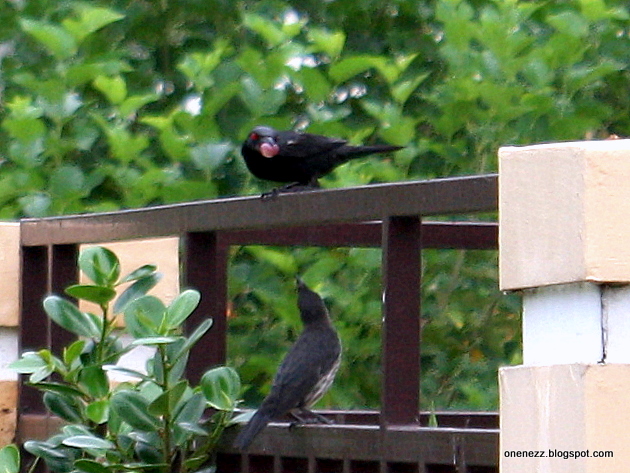
The male fledgling actually fed the sister several times.
I find this action very strange and touching too.
Since the mother lays its eggs on others' nest, I suppose the fledglings could have gotten evicted before they are ready to fend for themselves.
Isn't it nice to have a big brother like this one?
He is but a fledgling himself.
Isn't it nice to have a big brother like this one?
He is but a fledgling himself.

19 Dec 2011 Update
The Asian Koels have red eyes and so do the Asian Glossy Starlings.
However the beak of the Asian Glossy Starlings are black but the Asian Koel's beak is much lighter.
These small birds that looked like the juvenile of the Asian Koels are actually Asian Glossy Starlings.
The black Asian Glossy Starling was feeding a juvenile Asian Glossy Starling in the second last photo.
To date they have remained small and definitely do not look like they are growing into the size of an Asian Koel.

